25 ESP32 Projects for 2026: Beginner to Advanced (with ESPHome Ideas)
On this page(9 sections)
The best ESP32 projects for 2026 range from a 30-minute Wi-Fi relay to a Home Assistant voice satellite, and most of them need less than $30 in parts. Below are 25 ideas grouped into beginner, Home Assistant and ESPHome, workshop and garage, displays and cameras, and advanced builds, each with a parts list and difficulty rating. Where we've already published a full build guide, the project links straight to it.
Which ESP32 Board Should You Use?
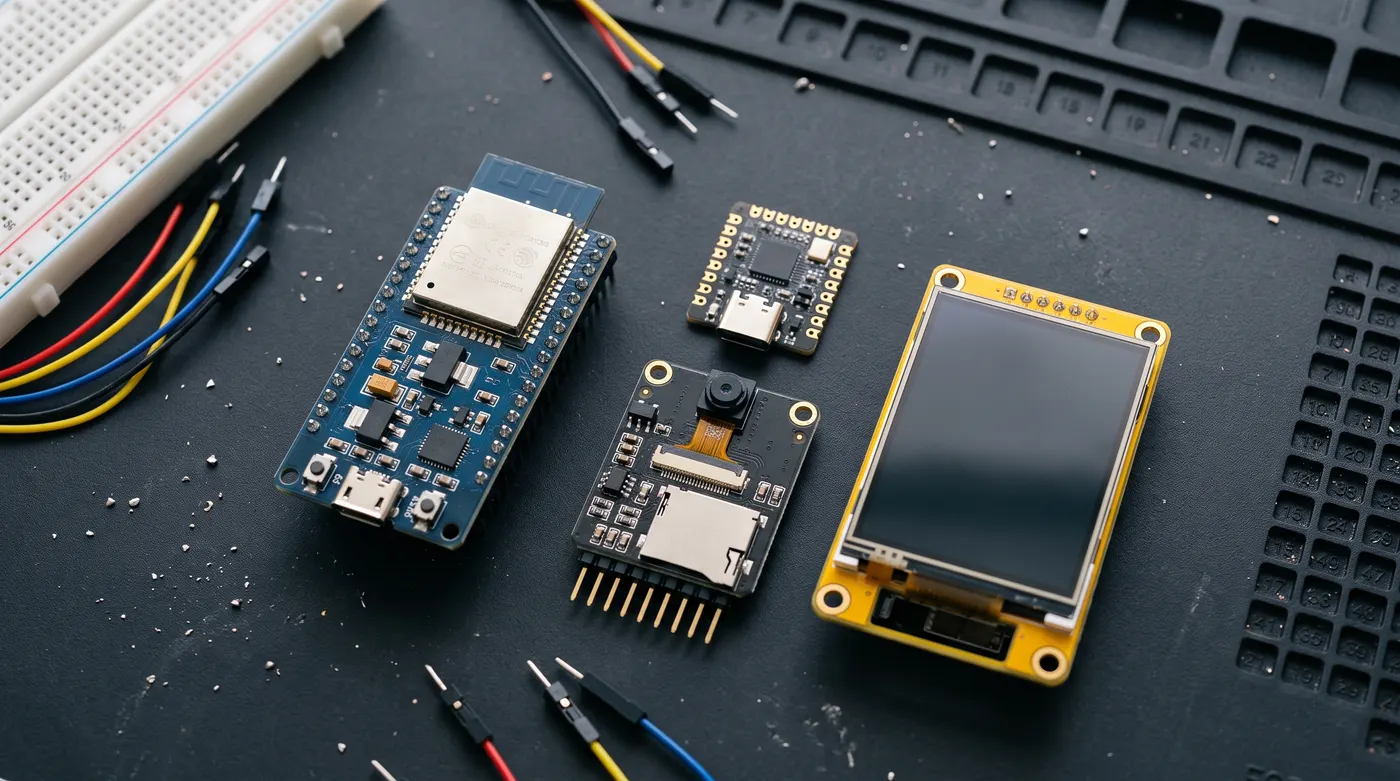
"ESP32" is a family of chips, not one board. Pick the one that matches the project:
| Board | Core | Radios | Typical Price | Best For |
|---|---|---|---|---|
| ESP32 (classic, WROOM-32 DevKit) | Dual-core 240 MHz | Wi-Fi 4, Bluetooth Classic + BLE | $4–$10 | General projects, Bluetooth proxies, most tutorials |
| ESP32-S3 | Dual-core 240 MHz, AI vector instructions | Wi-Fi 4, BLE 5 | $7–$15 | Cameras, displays, voice, native USB, PSRAM-hungry builds |
| ESP32-C3 | Single-core RISC-V 160 MHz | Wi-Fi 4, BLE 5 | $3–$7 | Tiny, cheap sensor nodes |
| ESP32-C6 | Single-core RISC-V 160 MHz | Wi-Fi 6 (2.4 GHz), BLE 5, Thread/Zigbee | $5–$10 | Thread, Zigbee and Matter experiments |
| CYD (ESP32-2432S028R) | Classic ESP32 | Wi-Fi, BLE | $12–$20 | Touchscreen dashboards with a 2.8" display built in |
| ESP32-CAM (AI-Thinker) | Classic ESP32 + PSRAM | Wi-Fi, BLE | $7–$12 | Cheap camera projects, timelapses |
If you're not sure, buy a few classic ESP32 DevKits (look for USB-C and a CP2102 or CH340 USB chip) and one ESP32-S3 board with PSRAM. Between them they cover every project on this list except the Thread/Zigbee one. All of these boards use 2.4 GHz Wi-Fi only; Espressif's newer ESP32-C5 adds dual-band Wi-Fi 6, but support for it is still maturing.
Before You Start: Tools and Software
You'll need a breadboard, jumper wires, a multimeter, and a USB cable that actually carries data (charge-only cables are the number one cause of "my board isn't detected"). Several projects need a few solder joints on header pins; our beginner's guide to soldering covers the technique.
For software, there are two main routes:
- ESPHome: You describe the device in YAML, and ESPHome compiles and flashes the firmware, then exposes everything to Home Assistant automatically. The ESPHome Device Builder runs inside Home Assistant or in Docker. Best for sensors and automation.
- Arduino IDE or PlatformIO: Write C++ yourself. Best for displays, games, custom web servers and anything ESPHome doesn't support.
Beginner ESP32 Projects
1. Wi-Fi Relay Web Server
Host a tiny web page on the ESP32 that toggles a relay or LED from any phone on your network. It teaches GPIO, Wi-Fi station mode and the built-in WebServer library in an afternoon. Start by switching low-voltage loads like a 12V LED strip and leave mains wiring alone until you know exactly what you're doing.
Parts: ESP32 DevKit, 1–4 channel relay module (or an LED and resistor) · Difficulty: Beginner
2. Wi-Fi Weather Station
Our Arduino weather station build uses a BME280 and DHT22. Move it to an ESP32 and you can push readings to Home Assistant, InfluxDB or MQTT instead of a serial monitor; in ESPHome the whole thing is about 20 lines of YAML. Add deep sleep and an 18650 cell for an outdoor node.
Parts: ESP32, BME280 (I2C), radiation shield or vented enclosure, optional rain gauge · Difficulty: Beginner
3. NTP Internet Clock with OLED
Pull the exact time from an NTP server and show it on a 0.96" SSD1306 OLED or a TM1637 four-digit display, with daylight saving handled automatically by the time zone string. Add the current temperature from your weather station and it becomes a genuinely useful desk gadget.
Parts: ESP32 or ESP32-C3, SSD1306 OLED or TM1637 display · Difficulty: Beginner
4. Plant Soil Moisture Monitor
Wire a capacitive soil moisture sensor to an analog pin, deep sleep between readings, and get a notification when a plant needs water. Use the capacitive type, not the two-prong resistive probes, which corrode within weeks. On the classic ESP32, use an ADC1 pin (GPIO32–39), because ADC2 pins don't work while Wi-Fi is active.
Parts: ESP32-C3 or classic ESP32, capacitive soil sensor, LiPo or 18650 cell with a charger board · Difficulty: Beginner
5. Addressable LED Strips with WLED
Flash the free WLED firmware from your browser and you get a polished app, over 100 effects, presets, schedules and Home Assistant integration with zero code. Our custom LED strip lighting guide covers power injection, fusing and wiring for longer runs.
Parts: ESP32, WS2812B or SK6812 strip, 5V power supply sized for the strip, 330 Ω resistor, 1000 µF capacitor, optional 74AHCT125 level shifter · Difficulty: Beginner
Home Assistant and ESPHome Projects
6. ESPHome Bluetooth Proxy
A Bluetooth proxy relays nearby BLE devices (thermometers, plant sensors, smart locks, toothbrushes) to Home Assistant over your network, so your server's own Bluetooth range no longer matters. Scatter a few around the house and add the Bermuda integration for room-level presence tracking of phones and BLE tags. Ethernet boards like the WT32-ETH01 or Olimex ESP32-POE make the best proxies, because Wi-Fi and Bluetooth share the same radio.
Here's a minimal config for a classic ESP32:
esphome:
  name: ble-proxy-garage
  friendly_name: BLE Proxy Garage

esp32:
  board: esp32dev
  framework:
    type: esp-idf

logger:

api:
  encryption:
    key: !secret api_encryption_key

ota:
  - platform: esphome
    password: !secret ota_password

wifi:
  ssid: !secret wifi_ssid
  password: !secret wifi_password

esp32_ble_tracker:
  scan_parameters:
    active: true

bluetooth_proxy:
  active: true
Keep proxies lean: the Bluetooth stack uses a lot of RAM, and piling other components onto the same board is a common cause of crashes. ESPHome also offers ready-made proxy firmware you can flash straight from the browser.
Parts: Any ESP32 (classic, S3, C3 or C6), ideally with Ethernet · Difficulty: Beginner
7. mmWave Presence Sensor
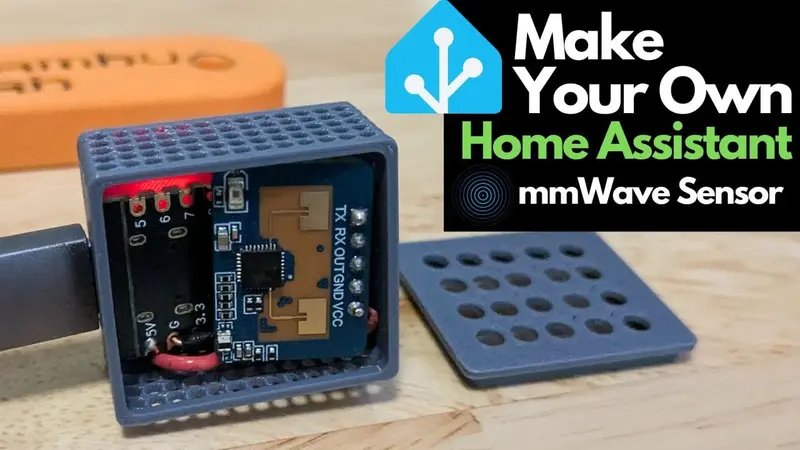
PIR sensors only see motion; an LD2410 mmWave radar knows you're still in the room while you read or type. Our ESP32 mmWave presence sensor guide walks through the wiring, ESPHome config and Home Assistant automations for about $15–$25.
Parts: ESP32, HiLink LD2410 or LD2410C, 5V supply · Difficulty: Beginner to Intermediate
8. CO2 and Air Quality Monitor
A Sensirion SCD40 or SCD41 measures real CO2, which is the best indicator of when a room needs fresh air. Add a PMS5003 particulate sensor for PM2.5 and let Home Assistant switch on an extractor fan or nag you to open a window. Skip the cheap MQ-135 "air quality" modules if you want actual CO2 readings.
Parts: ESP32, SCD40/SCD41 module, optional PMS5003 · Difficulty: Beginner to Intermediate
9. Utility Meter Pulse Reader
Most electricity meters blink an LED for every watt-hour used. Tape a light sensor module over it, use ESPHome's pulse_meter sensor, and feed the result straight into Home Assistant's Energy dashboard. Gas and water meters with a magnet or metal target can be read the same way with a reed switch or inductive sensor.
Parts: ESP32, light sensor module (or reed switch / inductive proximity sensor) · Difficulty: Beginner to Intermediate
10. Smart Garage Door Opener
A relay wired across the opener's wall-button terminals plus a magnetic reed switch for door position gives you open/close control and status in Home Assistant through ESPHome's cover component. Some newer openers use encrypted wall buttons that ignore a simple contact closure; open-source boards like ratgdo exist for exactly that case. Pair it with a "door left open" notification rather than fully automatic closing.
Parts: ESP32, relay module, magnetic reed switch, 5V supply · Difficulty: Intermediate
11. IR Blaster for Air Conditioners and TVs
ESPHome's infrared transmitter and its climate IR platforms turn many split-system air conditioners into proper thermostats in Home Assistant. Add an IR receiver to capture codes from any other remote and replay them from automations.
Parts: ESP32, IR LED with a driver transistor (or an IR transmitter module), TSOP38238 IR receiver · Difficulty: Beginner to Intermediate
12. Water Leak Detector with Automatic Shutoff
Leak probes under the washing machine, dishwasher and water heater trigger a motorised ball valve on the main supply and send an alert. It's one of the few smart home projects that can genuinely pay for itself the first time it fires.
Parts: ESP32, leak probes (or two exposed contacts), 12V motorised ball valve, relay, 12V supply · Difficulty: Intermediate
Workshop and Garage ESP32 Projects
13. Garage Climate Monitor (Rust Prevention)
Our Rust Defender garage climate monitor uses an ESP32 and DHT22 to calculate dew point in real time and switch a dehumidifier or heater before condensation forms on your tools and project car. It's a perfect first ESPHome build with a real payoff.
Parts: ESP32 DevKit, DHT22, 10k resistor, project box · Difficulty: Beginner
14. CT Clamp Energy Monitor for Big Tools
Clamp non-invasive SCT-013 current transformers around the circuits feeding your welder and compressor, read them through an ADS1115, and see exactly what each tool costs to run. The full build, including the safety warnings, is in our CT clamp workshop energy monitor guide.
Parts: ESP32, SCT-013 clamps, ADS1115 ADC, bias resistors and capacitor · Difficulty: Intermediate
15. Automated Dust Collection
Detect when a saw or sander starts drawing current, open the right blast gate with a servo and switch on the dust collector automatically. Our automated dust collection build uses an Arduino Nano; an ESP32 version adds Home Assistant logging and a remote override from your phone.
Parts: ESP32 or Arduino Nano, current sensors, servos, 3D-printed blast gates, relay for the collector · Difficulty: Intermediate
16. Garage Parking Assistant
A distance sensor on the back wall drives a short LED strip that goes green, amber, then red as you approach the perfect parking spot. A VL53L1X time-of-flight sensor is more reliable than an ultrasonic module against odd surfaces like number plates and bumpers.
Parts: ESP32, VL53L1X or HC-SR04 (use a divider on its 5V echo pin), short WS2812B strip · Difficulty: Beginner to Intermediate
17. 12V Battery Monitor for Stored Vehicles
Keep an eye on the battery of a project car, motorcycle or caravan that sits for months. An INA219 or INA226 module (or a simple voltage divider) reports voltage to Home Assistant, which alerts you before the battery drops low enough to be damaged. Power the ESP32 through a fused buck converter and use deep sleep so the monitor isn't the thing that flattens the battery.
Parts: ESP32, INA226 module or resistor divider, 12V-to-5V buck converter, inline fuse · Difficulty: Intermediate
ESP32 Display and Camera Projects
18. CYD Home Assistant Control Panel
The "Cheap Yellow Display" (ESP32-2432S028R) packs an ESP32, a 2.8" 320x240 touchscreen, an SD slot and an RGB LED onto one board. ESPHome's LVGL support or the openHASP firmware turns it into a wall or desk panel with buttons for lights, scenes and sensor readouts. Check which display driver your batch uses, since some CYD variants ship with different controllers.
Parts: CYD board, 3D-printed stand or wall mount, USB power · Difficulty: Intermediate
19. CYD Desk Dashboard or 3D Printer Monitor
Program the CYD in Arduino with TFT_eSPI or LovyanGFX and show anything with an API: weather, calendar, server stats, or your 3D printer's progress from Klipper/Moonraker or OctoPrint. The community "ESP32-Cheap-Yellow-Display" repository on GitHub has pin maps and examples to start from.
Parts: CYD board · Difficulty: Beginner to Intermediate
20. E-Paper Weather and Calendar Display
E-paper only uses power when it refreshes, so an ESP32 in deep sleep that wakes every 15–30 minutes can run for months on a battery. Show the forecast, your calendar and Home Assistant sensor values on a panel that looks like printed paper.
Parts: ESP32 (or an e-paper driver board), 4.2" or 7.5" e-paper panel, LiPo cell · Difficulty: Intermediate
21. ESP32-CAM Timelapse and Wildlife Camera
The ESP32-CAM is a complete Wi-Fi camera for around $10: capture a 3D print timelapse to microSD, build a bird feeder cam, or stream into Home Assistant with ESPHome's camera component. Its 2 MP OV2640 sensor is fine for snapshots but no substitute for a proper IP camera. It has no USB port, so get the ESP32-CAM-MB programmer board, or choose an ESP32-S3 camera board with native USB and more memory.
Parts: ESP32-CAM with MB adapter (or an ESP32-S3 camera board), microSD card, solid 5V 2A supply · Difficulty: Beginner to Intermediate
Advanced ESP32 Projects
22. ESP32-S3 Voice Satellite for Home Assistant
Build your own "Hey Jarvis" speaker with an ESP32-S3, an I2S microphone and an I2S amplifier. ESPHome's voice assistant and micro wake word components handle on-device wake word detection, then hand the audio to Home Assistant's Assist pipeline, which can run fully locally. Home Assistant's own Voice Preview Edition is the polished version of this project if you'd rather not tune microphones.
Parts: ESP32-S3 with PSRAM, INMP441 microphone, MAX98357A amplifier, small speaker · Difficulty: Advanced
23. CAN Bus Sniffer and Car Data Logger
The ESP32 has a built-in CAN controller (Espressif calls it TWAI). Add an SN65HVD230 3.3V transceiver and an OBD2 pigtail and you can log raw CAN frames to SD or stream them over Wi-Fi to SavvyCAN for reverse engineering. Always start in listen-only mode and never transmit onto a car's network unless you know exactly what the frame does.
Parts: ESP32, SN65HVD230 transceiver module, OBD2 pigtail, 12V-to-5V buck converter · Difficulty: Advanced
24. Meshtastic LoRa Off-Grid Messenger
Meshtastic turns ESP32 LoRa boards like the Heltec WiFi LoRa 32 V3 or LilyGo T-Beam into a long-range, off-grid text messaging mesh that pairs with your phone over Bluetooth. Flashing is easy; the advanced part is building weatherproof, solar-powered repeater nodes on high ground. Use the correct frequency band for your region.
Parts: ESP32-S3 LoRa board, proper antenna, battery, optional solar panel and charge controller · Difficulty: Intermediate to Advanced
25. Thread or Zigbee Device on ESP32-C6
The ESP32-C6 has an 802.15.4 radio, the same physical layer used by Thread and Zigbee. The Arduino ESP32 core ships Zigbee examples, Espressif's ESP-Matter SDK supports Matter over Thread, and ESPHome has been adding OpenThread support. Build a battery-powered Zigbee sensor that pairs with Zigbee2MQTT or ZHA, or a Matter-over-Thread device for your Thread network.
Parts: ESP32-C6 DevKit or Seeed XIAO ESP32C6, sensor of your choice, LiPo cell · Difficulty: Advanced
FAQ
What is the best ESP32 board for beginners?
A classic ESP32 DevKit (WROOM-32) with a USB-C port. It's cheap, works with almost every tutorial and library, and supports both Wi-Fi and Bluetooth. Move to an ESP32-S3 once you need cameras, larger displays or voice.
Should I use ESPHome or Arduino for ESP32 projects?
Use ESPHome for anything that ends up in Home Assistant: sensors, relays, presence, energy monitoring and Bluetooth proxies. Use Arduino or PlatformIO for custom graphics, games, web servers and projects ESPHome doesn't cover. Many people end up using both.
Can an ESP32 connect to 5 GHz Wi-Fi?
The classic ESP32, S3, C3 and C6 are 2.4 GHz only. Most routers broadcast both bands, so this rarely matters, but make sure the 2.4 GHz band is enabled. The newer ESP32-C5 adds 5 GHz support if you specifically need it.
What can you do with an ESP32 Cheap Yellow Display?
The CYD is ideal for touchscreen projects: Home Assistant control panels, weather and calendar displays, 3D printer monitors, server dashboards and simple games. It's a full ESP32 with a screen, so anything you can do on a regular ESP32 still applies.
Do I need a Bluetooth proxy if my Home Assistant server has Bluetooth?
Not strictly, but the built-in adapter only covers a room or two, and USB Bluetooth on servers is often flaky. A couple of ESPHome Bluetooth proxies placed around the house give better range and reliability, and they're needed for room-level tracking with Bermuda.
Conclusion
The ESP32 is still the best value in hobby electronics: a few dollars buys Wi-Fi, Bluetooth and enough processing power for everything from a plant sensor to a voice assistant. Start with a beginner project or a Bluetooth proxy to learn the ESPHome workflow, then move on to the workshop builds where the payoff is real: fewer rusty tools, lower power bills and cleaner air. Pick one project from this list, order the parts, and build it this weekend.